Monday, February 10, 2014

Part #2 of Bed Turning - an Eclectic Mix


See Bed Turning-Part #1 by clicking here.

Continuing with our first Bed Turning from the October 20, 2013 meeting of the Washington Quilt Study Group. 


10.  Kathy Anderson:  This appears to be a basic Shoe Fly pattern with color placement variations. See BB# 1645 page 209 in Barbara Brackman's Encyclopedia of Pieced Patterns (1993) (ISBN 0-89145-815-8).

Beautiful example of finishing a vintage top.  Excellent use of reproduction fabrics to complement the original top.  Kathy finished the top approximately 8 years ago.  The backing is a great reproduction of mourning print fabric.  This quilt would have been a good addition to Mary Kerr’s study center, “To Finish or Not to Finish” at the 2013 AQSG Seminar in Charleston.


You can also read more about finishing old tops here and here


11.  Kathy Nannery:  Kathy brought a crazy quilt owned by a friend.  It was an estate sale purchase from Pennsylvania.  Scrap-bag top with fabrics 1880s-1910 era.  Fabrics appear to be from work clothes, possibly railroad uniforms.  Many people worked for the railroad in the area the top was purchased.   Quilt maker turned right side of backing fabric toward the "inside" of the top so that it could not be seen from either the front or back of the piece—interesting she would do that.  If you still have your photos and notes from Ginny Gunn’s 2012 Study Center you could probably assign closer dates on some of the late 19th and early 20th century quilts.  Might be a good future study group topic.


12.  Susan Underwood: Dark brown, pink, and beige “southern” quilt with checked backing fabric.  Purchased from Cindy Rennels, Oklahoma, in 2000.  Probably 1880-1900.  Very dark brown print fabric has not faded—possibly a vegetable dye referred to as “chocolate brown” (Brackman “Clues”).  Possible Southern indicators: boldness and scale of design (?), thick bat (upper South), fan quilting and the spacing of the fan quilting, gingham check back, knots on surface of quilting.


13.  Margaret Parcel: Tumbler quilt.  Family quilt.  Scrap-bag quilt with a wide range of fabrics.  Includes “Garibaldi” prints (red and black), blue prints with flashes of cheddar orange.  1880-1900?


(See page 118 of Dating Fabrics-A Color Guide 1800-1960 by Eileen Jahnke Trestain for examples of red & black as well as Margo Krager's website Cottonopia, where you can click thru to reproduction attempts of this particular color/design.)


 In addition, you might enjoy reading Kyle Redente's story about her efforts to re-pieice a top with a few “Garibaldi” prints in it.


14.  Dawn Barrow:  Delectable Mountains, blue on what is now a tan background.  Probably a fine quilt when made—beautiful quilting.  Very large, top is folded over to the back for binding.  Second half of 19th century, probably closer to 1860.  Backing fabric also indicates an earlier date.  Memorable feature is the iron-on tape used to mend the back. Brackman's BB#2401 on page 303 seems to most resemble this pattern.


15.  Kathy Nannery:  Second quilt Kathy brought for her friend Jean.  Quilt is dated 1919.  Beautiful bright colored fabrics.  Quilt does not have the elaborate variety of stitches of many 19th century crazy quilts.  Only one stitch used around each block (feather stitch?).  No embroidered flowers, names, etc.  The fabric pieces are smaller than the typical crazy in the heyday of this style.  Fabrics possibly from a dressmaker’s stash rather than the larger pieces collected by a Victorian lady specifically for her crazy quilt.  The fabrics not the stitching dominate the quilt.  Fabrics could also be purchased by the pound for quilts, but these are particularly nice fabrics.  The brilliant pink repeat ties the design together well.

If you would like to read more about the history of Crazy Quilts, check out Cindy Brick's book and Penny McMorrison's book. Both are excellent quilt history books. Alex Anderson and Ricky Tims also have an interesting segment on Cindy here. (However, you'll have to be a paid member to watch it.)


16.  Kathy Nannery:  9-patch alternating with square blocks of a “faux” fabric (the print mimics a woven fabric pattern).  Pieced blocks include one bears-paw square.  The pieced blocks are probably older than the “faux” squares, which are the alternative blocks.  Pieced blocks appear to be 1880-1890.  The “faux” squares appear to be early 20th century, but more research would be needed to confirm this.


17.  Delaine Gately:  Red and blue 8-point diamond stars on a white ground with wonderful, elaborate quilting.  Unique leaf quilting pattern in the borders.  Circa 1870?


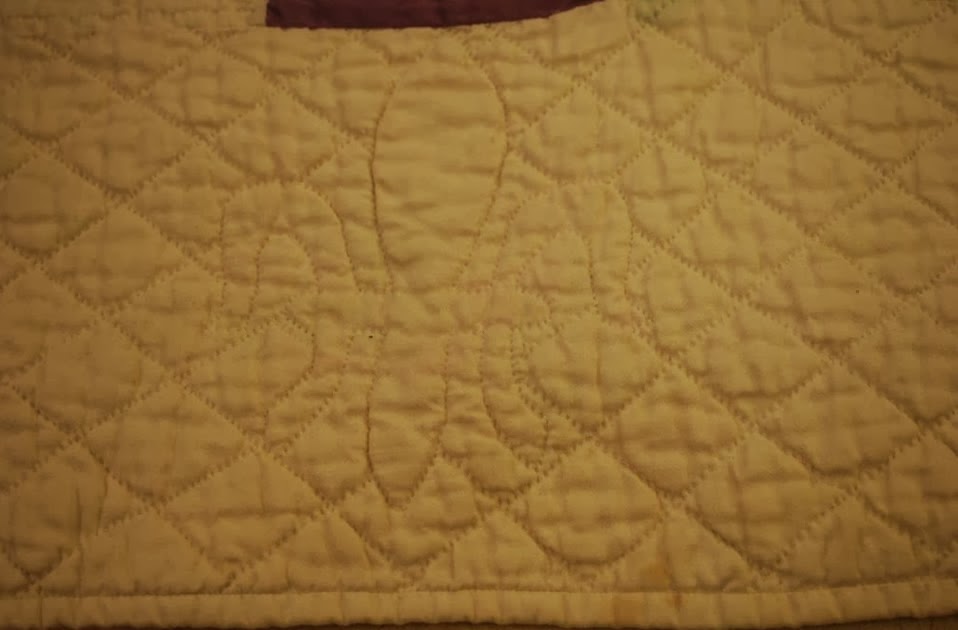
18.  Delaine Gately:  Appliqued lavender, purple, and green tulips with purple sashing on cream background.  Made by Helen Estey (?) of Illinois  (Karen, my notes are sketchy on the reference to Helen Estey).  Quilt has been appraised and it is an original pattern.  Diamond quilting with flor de lis pattern in border; quilting is 12 stitches per inch.  Stems and leaves are of green sateen, a fabric Marie Webster used in many of her quilts.


Wednesday, December 18, 2013

Bed Turning - an Eclectic Mix

The Western Washington Quilt Study Group was officially "re-launched" with its first meeting held south of Tacoma on October 20, 2013 at the Business School, Pacific Lutheran University with 20 members present.

It is our goal to share our love and appreciation of our "mother ship" — the American Quilt Study Group (headquartered in Lincoln, Nebraska), along with our love of quilts, quilt history and the history of the cotton textile industry world wide.

AQSG members Joy Neal, Karen Alexander and Susan Underwood are co-leaders of the newly launched group. We began the morning by asking each person to introduce herself and to tell us a little about how she came to be interested in quilt history. After everyone had shared, Karen Alexander presented a brief background about the major quilt history organizations: the American Quilt Study Group; The Alliance for American Quilts and its four major divisions--The Quilt Index, Quilters Save Our Stories, Quilt Treasures, and Boxes Under the Bed; the International Quilt Study Center in Lincoln, Nebraska; and The Quilters Hall of Fame in Marion, Indiana.

Research books and binders, handouts from AQSG and past copies of Uncoverings were made available for viewing, as well as handouts from other organizations mentioned above.

Members present were asked for in-put about what they would like to see future meetings cover. We also discussed the idea of meeting at and working with some of the museums and/or historical societies around the State to help them identify the quilts in their quilt collections.

PS: The BB# reference numbers you will see from time to time come from Barbara Brackman's Encyclopedia of Pieced Patterns (1993) (ISBN 0-89145-815-8) or Brackman's Encyclopedia of Applique (1993) (ISBN 0-939009-75-7).


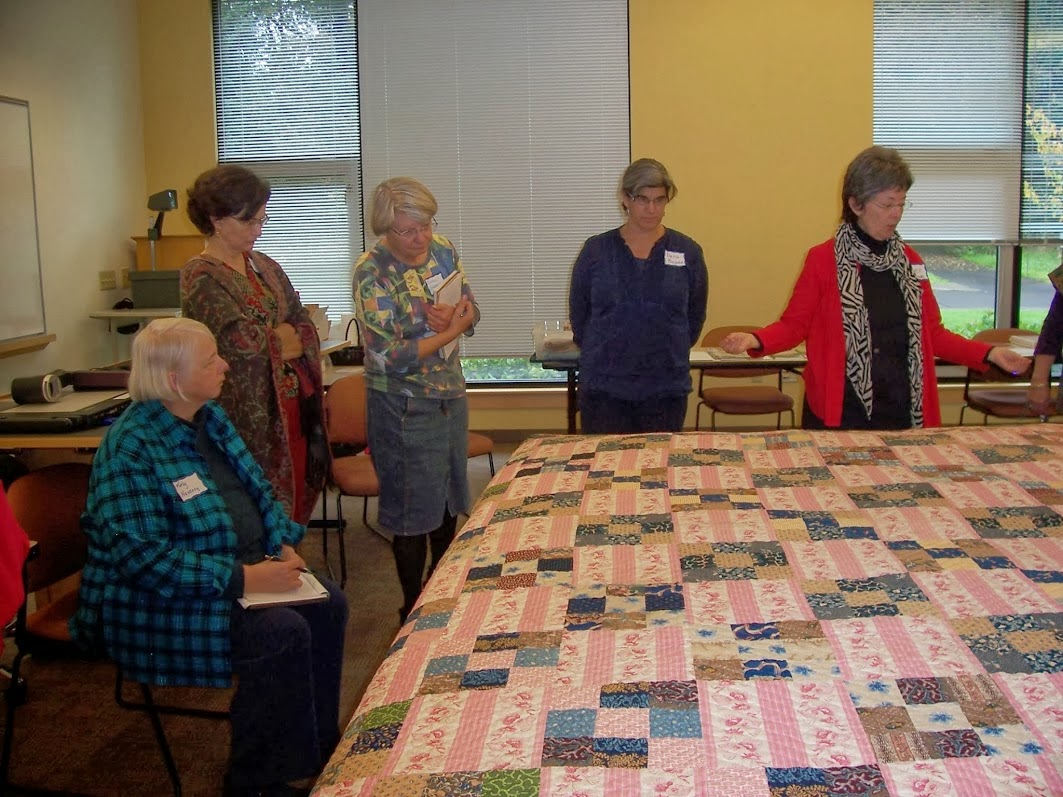
This series of photos of the members was taken by Joy Neal.


Our First Program

Our first program was a Bed Turning with everyone encouraged to bring one or two quilts. The quilts were then layered from oldest (top) to newest (bottom). Each owner was encouraged to tell us what they knew about the piece and to ask questions of the group.  We then shared our questions, ideas, and opinions about each quilt as it was shown.

Some brief notes on each quilt follow, thanks to Susan Underwood, with photographs thanks to Christine Turner.

Each owner/member is welcome to email Karen Alexander with more details to be added to the blog record. The more we share, the more we learn. (The quilt owner's name is listed first.)

(1) Karen Alexander - The oldest quilt shared — an 1840’s pieced quilt purchased on e-bay.  It was an excellent collection of early 19th century fabrics, including a possible rainbow print.  It was suggested that such a quilt would be a good example for further study of dye and printing techniques.


2.  owner??      : summer spread, red and green center floral applique with scalloped edge bound in light (mint?) green.  Presented as a contrast of mid-20th century applique to the 19th century red and green applique that follows.  Scalloped edge, use of sewing machine, color of green fabric, and quality of button-hole applique stitch are all indicators of 20th century origin of this piece. The pattern is very similar to Tea Rose (BB# 18.33) which was a Carlie Sexton pattern. See page 78 in Brackman's Encyclopedia of Applique.


3.  Kathy Anderson:  Red and green floral applique, 1850-1870.  Purchased in Iowa.  Red-print fabric is an example of black and yellow dyes “eating” holes in the red background.  Iron-oxide dyes? Very interesting border for an applique quilt of this period. We could find no specific match in the Brackman applique book for this pattern.


Below we compare and contrast the greens in the two fabrics.


4.  Amelia Beadle:  Pieced quilt, colors typical of “Pennsylvania German” quilts of mid-19th century.  Purchased from man in a van, Paducah.  (Looking at the Brackman book, the closest pattern we found was BB#2060, published in 1931 as “Autumn Leaf”. We don't know the name this quilt-maker may have used for this pattern.)  Amelia dates the quilt to c. 1865, Pennsylvania.  Construction differences among the blocks indicate they might have been made by several people.  Amelia also asked if some of the blocks with darker “double pink” fabric could be from a slightly later date.  Note the print backing—white with multi-color polka dots.  Machine binding is much worn at edges—possibly a replacement binding?


5.  Amelia Beadle:  Pieced “star” blocks alternating with shirting print square blocks, 1860-1880.  Corners cut out for bed post but is not a full-size quilt; possibly for a child’s bed.  Star is composed of a center square with triangles.  (You can see variations of this block on page 267 of Brackman's Encyclopedia of Pieced Patterns; specifically BB#2138 a-d.) Fabric selection dramatically alters appearance of pieced blocks; compare the blocks made with 3 fabrics to the blocks made with 2 fabrics. Brackman gives a different # to each.


 6.  Kathy Anderson:  Indian Puzzle variation. BB# 2050 (Nancy Page)
Red & beige pieced quilt, pattern has a center square surrounded by 90 degree triangles.  Sashing and border triangles appear to be pieced but are cut from striped fabric.  Purchased Portland, Or.  Cut-out bed post corners are distinctive because of curvature added to accommodate post.  Careful use of striped fabric and interesting repairs—see photos.  Striped backing fabric has been carefully mended with remnants of the unfaded original fabric.  One block has shirting print triangles appliqued over the original fabric.  Estimated to be 1850s-1860s era although one blue block may have earlier fabric.


Indoor lighting can be very frustrating. The red in this quilt shows ups as a rusty brown.


7.  Joy Neal:  Top purchased from garage sale in 1990s.  Four-patch blocks alternate with plain blocks, diagonal set.  Small quilted square of same pattern and fabric, perhaps done as a doll quilt.  Quilt maker, in her 90s, was at the garage sale.  She told Joy it was made in the 1890s.  Some 1880’s fabrics are in the pieced blocks.


8.  Amelia Beadle: Blue and white “crazy Ann” block pattern.  “Later the block became confused with the swastika and was no longer made.”  Purchased from a man in a van whom Amelia met in Paducah.  Seller said quilt was from Massachusetts.  Brackman has this pattern as #1130b with 16 names including, swastika, flyfoot, whirligig, and the most interesting “pure symbol of Right Doctrine” (Hall).  That name sounds like a research project.  Crazy Ann was not listed by Brackman, may be a very personal name or a regional name.


9.  Carol Pittmon:  Log cabin, Barn Raising set, pink and brown with white shirting prints.  Blocks appear to have been done by more than one person.  Most are not foundation pieced, but 4 blocks are and some squares show more deliberate cutting of geometric prints than other blocks.  Only a few of the log cabin squares have a red center block; the other centers are light colored prints, many appear to be shirting prints.  Estimate 1890s-1910 based on color.


Stay tuned!

We will post more photos after Christmas!


THE NEXT MEETING


The next meeting of the Washington Quilt Study Group will be in Tacoma on Saturday, January 25, 2014, 10:00 am-2:00 pm.  Delaine Gately will present a program based on her collection of more than 200 quilts.  Delaine collects and lectures on antique quilts and histories of the quilt makers.  Among her many quilt and textile interests, Delaine makes art quilts and clothing.  Her work has been exhibited at the Pacific West Quilt Show and other major shows.   She is a member of the Western Washington Quilt Study Group and the American Quilt Study Group. 

Following is preliminary information about some programs we are planning for 2014.  All dates are tentative until we can confirm availability of location and program presenters.  We’ll let you know as soon as dates are confirmed.

March 2014: Meeting in La Conner with a program related to the La Conner Textile Museum collection.

Saturday, May 10:  Presentation of early 1800’s American, English, and French quilts by Mid-West collectors who are traveling to the Northwest at the invitation of Karen Alexander and the Western Washington Quilt Study Group.  On May 10 their program will done at a location south of Seattle.

Weekend of May 16-18: The Lopez Island Quilt Study Retreat Program will include signature quilts, quilt restoration and preservation, and the same Michigan collectors. (These are quilts that have not been seen on the West Coast before.) 

The full Retreat program is being developed but it will include a Bed Turning, and Show and Tell, and quilts at the Lopez Island Historical Society.  The historical societies on Orcas and San Juan Islands will also have quilts hanging that weekend.   Full information will be sent to you when the Retreat program is complete.

Topics suggested for programs in late 2014 and beyond include dating quilts from 1900 to 1930, Marie Webster and her quilts, and the impact of technology and the modern quilt movement.  Many who attended the October 20 meeting also expressed an interest in genealogy and researching signature quilts.  Let us know if you are interested in doing a program!

Enjoy the holiday season and we hope to see you in early 2014. 
Susan Underwood
Joy Neal
Karen Alexander